A technical research overview, for educational and research purposes only, not affiliated with Irdeto or Denuvo Software solutions GmbH. This aticlee is purely for an academical study, none of this work supports piracy, cracking or circumvention or copying of the protected application in any form.
Table of Contents
1. Intro
This document is basically a research upon the ongoing arms race with Denuvo Anti Tampering tech DRM, and from various sources, a research on the DRM it's working, and analysis of the end user's system. Thee purpose of putting this together is to have a single reference for someone who wants to discover more
Scope of this research:-
- Historical overview of Denuvo
- Hardware fingerprinting mechanisms in details
- Hypervisor architecture fundamentals
- Structured representation of the "CrackL@b RE:Requiem analysis (all credits goes to the OG authors)"
- Design overview of WHP based (Ring 3) alternative approach research
- Detection methods for hypeervisor based env
- Security risks while usage of hypervisor
- and comparison table between different approach of software piracy
2. Denuvo
Denuvo Anti-Tamper is considered one of the most sophisticated DRM system ever deployed. Developed by an Austrian company-Denuvo Software Solutions GmbH, which is now a subsidiary of Irdeto.
It has been dominant on anti piracy layer for major AAA titles ever since it was introduced back in 2014. The team behind it came largely from creators of SecuROM, which was Sony DADC's earlier CD/DVD based DRM system. When physical meedia DRM became less relevant with the shift to the digital media, they basically built something fundamentally different- an anti tamper layer, that is woven INTO the executable itself ( DO NOTE THAT THE EXECUTEABLE CAN ALSO BE ANY BINARY NOT JUST A NATIVE WINDOWS .EXE, IT ALSO CAN BE A .DLL, LIKE IN WATCHDOGS), not just sitting on top of it.
Origins and development time line
- 2014- Denuvo Anti-Tamper launches; first deployments on FIFA 15 and Lords of the Fallen
- 2015- Dragon Age: Inquisition and other titles adopt Denuvo; first 2 months pass without any cracks
- 2016- Some people started researching upon it, and some old titles eventually fell
- 2018- Irdeto acquires Denuvo Software Solutions GmbH; protection growing significantly
- 2020-2024- Only a few active crackers working on modeern Denuvo; most titles remain protected for months or even years
- Late 2025- Hypervisor based approach emerges(Rise of Denuvowo); a lot of titles appeared to fall, but the rate was low. and not a lot of AAA games
- Early 2026-Mid 2026- Almost all titles with Denuvo fell, via hypervisor approach
How Denuvo fundamentally works
Unlike traditional DRM, which check a licensee key at startup (or anything else) and are done with it, Denuvo(which is actually fully fucking BAKED into the games) takes a different and aggressive approach, more like adopting the style of our local, psychopathic girlfriend having serious trust issues, keeps on checking various things, from time to time, exactly the same way, Denuvo makees multiple checks, and each check has different things to look out for, it is not a DOOR which we could bypass, it is a group of gaurds working together, inside outside everywhere in the game. This makes Denuvo harder to be removed.
The flow is basically like this- before any OG game logic runs, Denuvo's code executes first. It collects a set of "Information" from your device and sends it to the Denuvo servers. Through some server side cryptographic process (the exact details of which are not publicly disclosed), a 'token' or 'license' file is returned and stored locally on the machine. All subsequent launches then verify against this stored token without a need to go online each time, which is why it works without internet(after it generates the token or license) in almost all the cases.
The clever part here is that the token itself encodes the expected hardware state. So if you copy it to another machine it simply won't work, because there will be information miss-match between the game and license. More on this "information" soon bellow. So because of this exact reason there was rise of DenuvOwO(the hypervisor approach). This approach DOES NOT CRACK denuvo it kinda bypasses it, or let's just say "fools it".
Hardware fingerprinting mechanism
Rather than relying on a single indentifier, Denuvo builds a composite profile from many different sources. As per Connor-Jay Dunn's public analysis, the confirmed checks include the following and it is worth noting that this list may not be fully exhaustive, as Denuvo keep updating it's internals:
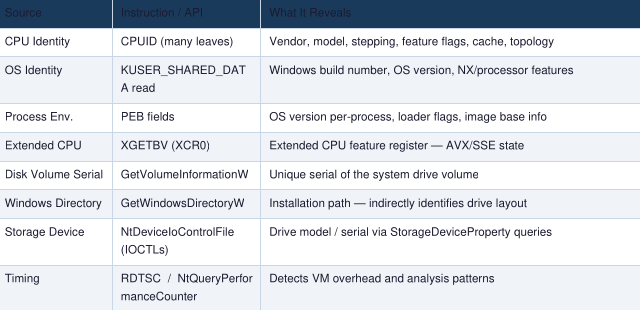
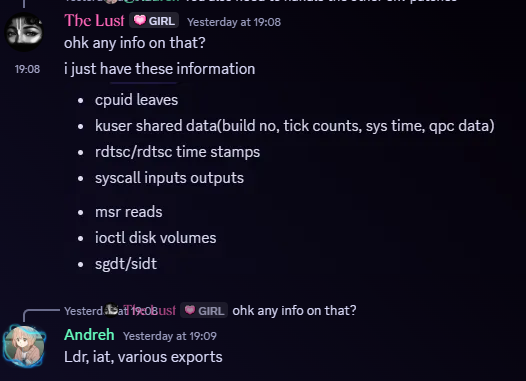
Token based license architecture
On first launch, the hardware fingerprint is collecteed and sent to Denuvo'servers. The server combine these values with license entitlement info from the sales platform(Steam, Epic Games, Ubisoft, EA) and returns a signed token/license file which is stored locally on the machine. As per the research, this token is valid only for a specific hardware, not just for a specific user account, and this is both what makes Denuvo effective and also what makes the hypervisor-based bypass viable in the first place, because if you control the fingerprint, you essentially control what token gets accepted.
Now here are 2 plot twists >///< - Denuvo along with those hardware information, needs platform information, like from steam it needs, session auth-encrypted app ticket(which is 5 tickets per 24 hours each, and can only be made if the steam account owns the steam app in the question; each of these ticket are valid for 20-30 mins), now it may differ from different platform, but the set limit of 5 tickets and quick expiry of each ticket, and generation of tickets for 24 hours, is common to all. So, no, you cannot generate a ticket if you do not have an account owning the product. - But with the use of Goldberg's steam emulator or nay other working and decent steam emu, or any other emu for other platform, we can provide the game, a ticket, which is fresh and activate in under 30 mins(run the game with this ticket) I will get a token/license file from Denuvo server, which has my device's hardware info, and the ticket I used.
Now why is this a twist, well because "tickets" are not hardware bound at all, it is linked to a user or sometimes not(or people can just bypass that requirement kind off, like my friend Andreh could- mans a fucking genius). And usage of steam emulator like GBE/GSE(goldberg steam emu), gets rid of needing steam connected to the game, and we can get any ticket from anyone who owns the game, and if the ticket is valid, Denuvo just blindly gets information and ticket, and combines it with some special data and makes the token/license file. And we can bypass Denuvo a little and pirate play the game till, our hardware changes or something and we need a new fresh ticket(not a token/license file as it has old ticket which is bound to your old hardware and info).
The "special data", well the game on your device is kind off incomplete... it needs that token/license file to not only just match the current hardware, and the hardware info from the file. It also has some information of the game itself needed to run the game.
Here comes hypervisor bypass into the play,as you know if you a valid license file for exact same hardware information, you can copy paste and play otherwise nope. So the way is to make VM with all the info of your hardware into it and the game thinks "hmm.... looks legit ngl boot the game up". Done, but VM will bring to much overhead, as well as we need GPU pass-thru. Hence hypervisor made out of SimpleSVM/HyperDBG, the minimal hypervisor setups an env like a VM which sits between the game and your real hardware.
Think of the hypervisor bypass like a translator, which knows languages A and B both, and there are 2 leaders, which when they talk to each other, this translator is present in between them, as Leader-1 speaks language A and Leader-2 speaks language B. So if you know you know lol, if the translator wants it can make each other fight, by intentionally lying to one of them or each other, to pass the different information from Leader 1 to Leader 2. This is how exactly the thing happens, the Leader 1 is your hardware system, and Leader 2 is your game, now Leader 1 is a system level having all access, and Leader 2 is on less powerful level it needs to ask from different ways to get information from Leader 1 about the system and then work.
So your Denuvo game sits on ring 3, which can access information to your system via different methods, but note the thing, it has to ASK for those information, the hypervisor which sits between them, allows the game calls for information verification against the provided token/license file from the system, but while the system returns those information of your current system, hypervisor catches it, modifies it and sends back the game a spoofed information which matches the system information in the token/license file, and the game works, even if the real hardware is totally different, and it does not need a ticket to work, just a token/license file and a same hypervisor bypass files running on your kernel and system. This also solves the VM overhead problems, as well as gpu pass through problem.
Performance of games with Denuvo DRM
Denuvo has faced significant criticism over the years regarding its performance impact on games. Some titles like Tekken 7 and Sonic Mania showed measurably improved frame times after Denuvo was removed, which caused quite a big backlash. The company has disputed these claims, and honestly the truth varies by title and by hardware configuration. Academically speaking, a 2025 paper in Entertainment Computing (Volckmann) found that Denuvo protection is associated with a mean 15% and median 20% protection of first-week revenue from piracy losses. Moreover, if a title survives uncracked for 12+ weeks, piracy causes essentially zero measurable revenue loss — which is the core commercial argument for the 'delay' model of DRM, i.e. you don't have to be unbreakable forever, just long enough.
3. Windows Kernel
To understand how the hypervisor approach works in full details and why certain hardware checks can be intercepted at the hypervisor level, we first need to go through the specific Windows kernel data structures and CPU instructions that Denuvo relies on. These are the actual building blocks of the fingerprinting mechanism, and understanding each one makes the whole bypass approach much clearer to analyse.
( Click here for more detailed information )
4. Hypervisors (concepts and Architecture)
A hypervisor is also called a Virtual Machine Monitor or VMM is software that creates and manages virtual machines by mediating access to physical hardware. Understanding hypervisor architecture is essential to understanding both why the bypass approach works the way it does and what its actual detection surface is, because these are two sides of the same coin. Also eventually VMs use hypervisor, so does a lot of things even Windows itself ships users with its own Hyper-V WHP hypervisor, as well as Android emulators like BlueStacks also has a version dedicated to work with WHP(more on WHP later), btw WHP=Windows Hypervisor Platform.
( Click here for more detailed information )
5. Analysis of hypervisor crack bypass
FULL CREDIT —
Rose / Natasha (0x80000003) @ CrackL@b Original title: 'Analyzing a Denuvo bypass approach based on virtualization.' Author: Rose / Natasha (0x80000003) | Platform: CrackL@b 2026
Co-credits:
Marius (Nitr0-G) — Denuvo analysis; Eintim23 — article review; momo5502 — EPT hook detection research; SinaKarvandi — HyperDBG. This section is a structured re-presentation of that research with added context. All findings belong to the original authors. This paper does NOT endorse bypassing copy protection in any form.
Overview
The CrackL@b article is one of the most detailed public write-ups on a hypervisor based DRM env spoofing implementation that has been analyzed at a technical level publicly. The specific sample that was studied was the bypass DLL from a Resident Evil: Requiem release. The article's stated purpose is explicitly educational, to analyse the technical approach and to also inform Denuvo's team about what the detection surface looks like. The author explicitly does not support or condone piracy in any form. What makes this analysis particularly valuable is that it goes both ways, it shows how the bypass works AND also what it's weaknesses are from a detection perspective, which is quite useful for understanding the whole picture.
( Click here for more detailed information )
6. WHP based research
Source Attribution
The architecture in this section is drawn from an extended design specification for a Windows Hypervisor Platform (WHP)-based kernel emulation research platform. It is included with approval. The platform is designed for legitimate security research — studying OS behavior, application compatibility, hypervisor introspection, and kernel data structures— operating entirely in Ring 3 without custom kernel drivers.
Design goals — why Ring 3 only?
The platform is built around one core constraint: everything must run in Ring 3 (user mode) with no custom kernel driver needed at all. This is achieved by leverging the WHP API, which exposes Hyper-V's Ring -1
functionality to user-mode code, which is quite a clever way to get hypervisor capabilities without any of the usual kernel-level complexity. The practical benefits are significant and worth listing out:
- No driver signing (DSE) bypass required — works on any standard Windows machine
- No risk of BSOD from hypervisor code bugs — crashes in user mode are isolated
- No kernel-level code conflicting with anti-cheat or anti-tamper systems
- Entirely standard Windows API calls — WHvCreatePartition, WHvCreateVirtualProcessor, etc.
- The underlying Hyper-V hypervisor handles hardware isolation at Ring -1 (unmodified,Microsoft-provideed)
The four core components of the platform are:
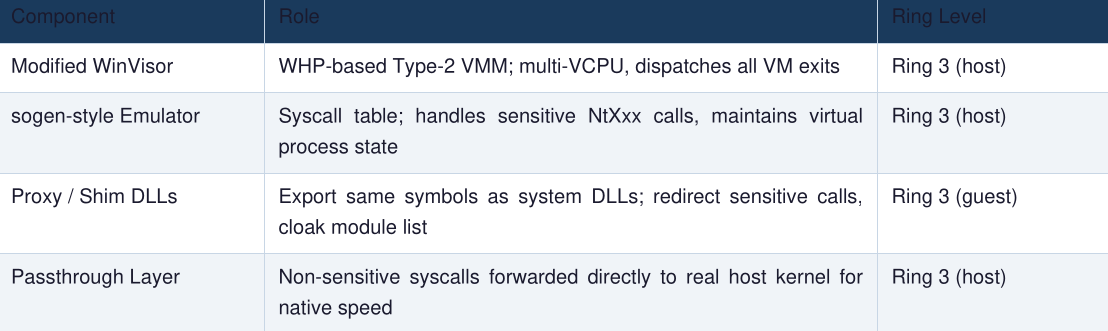 Okay so first let us talk about the basic features, and what I added in future and etc.
Multi VCPU support and thread virtualisation (shit is multi threaded)
The base WinVisor project (github.com/x86matthew/WinVisor) is single-threaded by default. The research platform extends it with multi-VCPU support, assigning each guest thread its own virtual processor via
WHvCreateVirtualProcessor. A separate host thread runs the WHvRunVirtualProcessor loop for each VCPU, which enables true concurrent execution across multiple cores. Thread synchronisation
primitives such as mutexes, events, and semaphores are passed through directly to the real host kernel to avoid having to re-implement complex scheduler logic from scratch. Only thread creation itself is intercepted, when NtCreateThread is called in the guest, a new VCPU is allocated and its TEB and GS base segment register are configured accordingly, then a new host VcpuThreadLoop is spawned to manage it.
VM exit dispatch handles five main categories: syscall exits (WHvExitReasonUserModeInstruction), EPT violations for monitored (WHvExitReasonX64Cpuid),memory MSR regions read/write (WHvExitReasonMemoryAccess),exits CPUIDexits (WHvExitReasonX64MsrRead/Write),and RDTSC/RDTSCP exits (WHvExitReasonX64Rdtsc/Rdtscp).
user mode Kernel emulation (sogen style)
Inspired by the sogen project (github.com/momo5502/sogen a high performance syscall level emulator for Windows and Linux), the kernel emulator maintains a private virtual state for the guest process. Sensitive syscalls are fully emulated and return spoofed data. Non-sensitive syscalls are forwarded to the real host kernel via a thin trampoline. GPU and display driver calls through win32k.sys are always passed through for native rendering performance. The virtual state maintained includes:
- Private handle table — tracks kernel object handles in the guest's namespace
- Object manager namespace — virtual representation of named kernel objects
- Virtual memory layout — tracks sections, heaps, and mapped views
- Thread and process lists — spoofed data returned to NtQuerySystemInformation
- Spoofed NtBuildNumber, NtMajorVersion, NtMinorVersion, debugger flags (KdDebuggerNotPresent),code integrity fields
The key syscalls emulated SystemHandleInformation, NtQuerySystemInformation SystemKernelDebuggerInformation, NtQueryInformationProcess NtProtectVirtualMemory, include: (ProcessDebugPort, NtCreateSection, (SystemProcessInformation, SystemCodeIntegrityInformation), ProcessDebugObjectHandle), NtQueryFullAttributesFile, NtQueryVirtualMemory, NtQueryValueKey, NtOpenKey, NtQueryPerformanceCounter, NtQuerySystemTime, and NtSetTimerResolution.
Trust the process, and just beear with me for a while now, just some more nerdy informations.
Proxy/Shim DLL layer
Instead of using the real ntdll.dll etc, the target application loads custom proxy DLLs exporting the same functions. Non-sensitive APIs are forwarded directly to real host DLLs via tail call jums. Sensitive APIs
trigger a syscall instruction that WHP catches. The proxy DLLs also manipulate PEB module lists (InLoadOrderModuleList, etc.) so the application sees only the original clean system DLLs — not the
emulator's custom libraries. For GPU operations, real host DLLs (d3d11.dll, dxgi.dll, etc.) are loaded into the guest address space so the game runs at native rendering speeee.
Magic CPUID Host Guest Communication Channel
A private hypercall interface uses special CPUID leaves as a communication channel between the user-mode loader and the hypervisor. These leaves are intercepted by the WHP exit handler and never reach the real CPUID hardware and the application sees nothing(kinda):
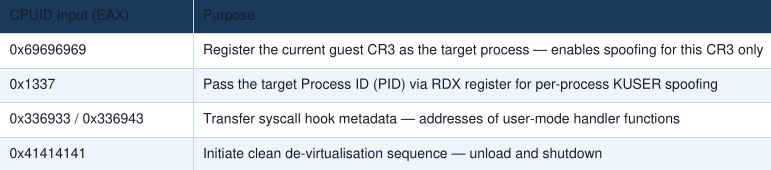
Note: CR3-targeted interception is a key design feature: spoofing/monitoring is only active when the guest CR3 register matches the target process's page table root. This prevents system-wide interference with other processes on the host.
Now the MOST awaited part :D
Okay so going back to the same example explanation in layman terms for hypervisor env based bypass cracks, of the 2 leaders, Leader-1 and Leader-2 and the common translator.
The story remains same, the translator will tell, the the Leader-2 AKA the game false shits, which is not from Leader-1 AKA your device, but things gets twisty here, these 3 people are in the domain of Leader-1, and it's gaurds are very loyal, which happen to know when you are doing "something"---- this something is done by translator due a third person, Leader-3 which is also present in Leader-1's domain, now the gaurds and Leader-3 and translator all speak the same single language.... which is a trouble for Leader-3 as gaurds won't let the translator do the "something"(more on this something later after the stry).
So, what did Leader-3 did was, it replaced the Leader-1's gaurd with it's own loyal people, but they did not take full control they just bought off some of the other gaurds too. WHY? well because.
The Leader-3 is a whole different KEERNEL system full fledged running and its similar to Leader-1, and has inbuilt hardcoded spoofing information, for the translator, so Leader-2 aka the game never gets any of those information which was spoofed. Now the bribery comes in play, it was done so that we reduce the fullness and complexity and sie of Leader-3, it will only spoof what's needed, rest things and even GPU calls and usage, etc is fall through, that is from Leader-1.
Therefore when I sum it all up, we have a sogen like emulator but very minimal and it is no longer a user space emulator, it emulates a custom hardcoded spoofed kernel and has fall thrus and working is done by modified winvisor(modified to make it light and connected to the proxy DLLS and our emu, and for better usage we make it a type 2 hyprvisor, for full work coverage, and hence it uses WHP and sogen emu is also WHP and both are connected and minimal and multi threaded, the over head is very fricking low!) and yeah the gaurds are the kernel DLLs used by games to access information, aka from Leader-1.
It is true this approach is not fully ring 1, but the fact it does not use any bypass or code, or disabling security and all the binaries are ring 3 and can be updated easily and is universal for not just denuvo or any game it can be used i applications and bianries for research. Which can be helpful to do a lot of things, and the best part is, this thing can be customised, so if there's something you do not want it- you remove, if you need something- you add, and can combine different things run on lower level rings etc for a lot of information. Use it as dumper or logger, or server based emu,a nd shoving API's and things- to make it wide and however you want, it is like "Transfomium" it can be programmed to whatever you want it to be! And it is not Intel or AMD specific too.
7. Detecting hypervisor based env
From a defensive standpoint which is the perspective of genuine interest to DRM developers and security researchers detecting when code is running inside a hypervisor is a well-studied problem, and several techniques are known. The CrackL@b analysis covers many of these in reasonable detail. This seection summarises the main approaches and also discusses how practical each one actually is in real-world conditions, ecause not all of them are as reliable as they might seem on paper.
Important Warning
The detection techniques below are presented from a theoretical and research perspective to understand the detection surface of hypervisor environments. Useful for DRM developers, security researchers, and OS engineers etc not for bypassing any security check.
( Click here for more detailed information )
8. Security risks of kernel level bypass tooling
The CrackL@b author raises this point with considerable directness in the original write up, and it is worth addressing seriously here as wel because it illustrates a fundamental asymmetry in the trust model of any system that requires privileged code execution from an untrusted source. Specially if the source is not open, and more importantly when it has encrypted and obfuscated binaries.... Unlike the DenuvOwO team, they ship binaries, as well as the token, and the source code for both drivers, and GBE/GSE based emulators etc, all things ready to use. Also the source has the values pre set to your needs, so yeah you need to look for sussy things if not, compile and run your own compiled version and working well.
The CrackL@b author makes a very pointed observation: if the people releasing these kernel-level tools wanted to include malicious code, an info stealer, a rootkit, a cryptocurrency miner, they easily could. The driver can simply be obfuscated with the excuse of 'protecting bypass techniques from Denuvo detection,' and no one would know the difference. And since they already instruct users to disable all security settings before running anything, executing whatever code they want on those computers is not at all difficult for them.
Moreover, unlike established software companies that have legal accountability and business incentives to maintain trust, the anonymous distribution model of scene releases provides essentially no accountability whatsoever. It's is just a time competition on who releases first — reputation matters far less in that context, as he CrackL@b author also notes. So from a purely practical security standpoint, running any unsigned kernel driver from anonymous internet sources on a machine that you actually care about is genuinely not a good idea at all. In this regard, the WHPbased approach described in Section 6 is considerably safer it requires no kernel driver, runs entirely in Ring 3, and can be audited by anyone who reads the source code.
Critical Security Warning — Running Unsigned Kernel Drivers
The bypass requires loading unsigned kernel drivers (Ring 0 code) onto the target system. This represents an extreme security risk. The bypass requires the user to: - Disable Driver Signature Enforcement (DSE) - Disable PatchGuard - Potentially disable Windows Defender - Disable Virtualization Based Security (VBS) - Disable KVA SHadow - Windows Hello - Windows Core Isolation - In earlier releases: disable Secure Boot via firmware modification (EfiGuard) A system in this state has no kernellevel protection. Any kernel driver running can read all process memory, capture keystrokes, install persistent rootkits, and perform any privileged operation without any limitation.
So If i were you I'd always prefer cs.rin.ru ones they are verified, and also trusted, and comes with the source code and values written in source. The thing is that a lot of things we do not need to disable to do the same thing which what can be done with the idea in Section 6, created purely by me and only me, and I could not have done even 1% of it without the help of my friends and the guy who told me, "You do need to emulate everything", and also trust the actual realeases by official accounts on the web itself.. not anyone from the web or on the web not trusted(which i dont think will happen, but the first one is imp).
9. Conclusions
This paper has tried to provide a comprehensive, technically grounded, and balanced overview of Denuvo DRM technology and the hypervisor based env spoofing approach that emerged in late 2025/early 2026 Key takeaways: - Deenuvo works by building a composite hardware fingerprint and binding a cryptographic token to it it's fundamentally an env identity problem, not just a cryptographic one. - The hypervisor based approach sidesteps cryptography entirely by making the hardware appear as a known, pre tokenised identity. It's an env manipulation attack, not a code analysis attack. - Both the hardware fingerprinting mechanism (CPUID leaves, KUSER_SHARED_DATA, RDTSC, MSR, storage IOCTLs) and the detection surface (EPT hooks, CPUID hypervisor leaves, timing, DSE) are now well understood by the research community. - The WHP-based Ring 3 research platform offers an interesting and safer alternative for legitimate security research — no custom kernel code, fully in user mode, no DSE bypass needed. BUT it does uses WHP, Hyper-V hypervisor of windows, now this is not purely ring 3, but hear me out, this method is like a passenger on station WHP API's are local trains, and the head ofice of the station is the actual windows' hypervisor, so.... we did nto hijack or bypass, we just asked for some help :D - The security risks of running unsigned kernel drivers from anonymous sources are severe and should not be underestimated by anyone evaluating these tools for any purpose. - The detection problem is genuinely hard given the prevalence of legitimate Hyper-V use on modern Windows, and any solution must carefully balance detection effectiveness against false positive risk for legitimate end users. - he CrackL@b analysis by Rose/Natasha (0x80000003) is exemplary security research it analyzes atechnique objectively, explains the detection surface clearly, and does so with explicit disclaimers about not supporting piracy.
Final Note — Ken Kaneki
The intersection of DRM technology, hypervisor architecture, and kernel security engineering is one of the most technically demanding areas of systems research. The fact that this plays out in the consumer gaming space makes it accessible to a wide audience, which is both a strength and a risk; accessible information can be misused.
The intended takeaway from this document is not 'here is how to bypass Denuvo' but 'here is how DRM fingerprinting works, how hypervisors can intercept it, and why this is a hard problem to solve from both sides.' That understanding has legitimate value.
Support the games you love. Support the developers who made them.
10. Refrences, credits and Exposé c:<
( Click here for more detailed information )
© 2026 Kaneki Ken. All rights reserved. This document is produced for educational and research purposes only. No portion of this document may be used to facilitate copyright infringement, software piracy, or any circumvention of copy protection in violation of applicable law. The author claims no ownership of the underlying research by Rose/Natasha (0x80000003), Connor-Jay Dunn, or any third party projects referenced herein — those belong to their respective creators. This compilation and additional analysis © Kaneki Ken 2026.
My socials-
Github: Kaneki Ken
Discord Id:- nanami.sai